 Get in touch
Sources last verified: 28 October 2026
Official sources cited at the end of this page.
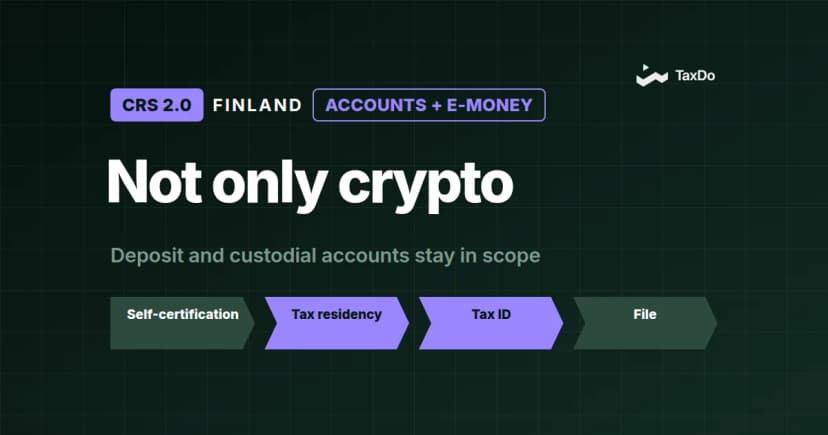
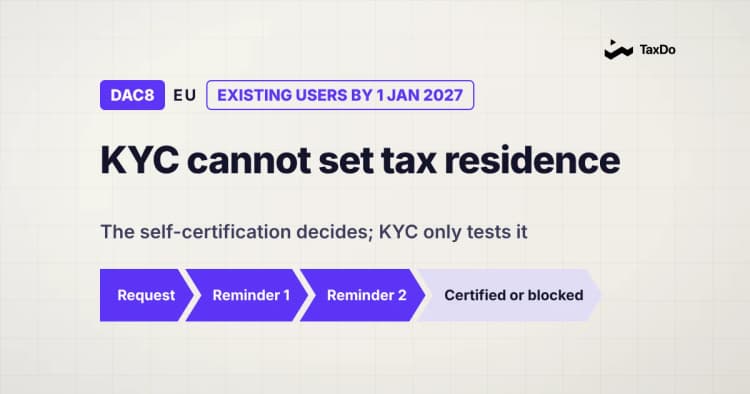
Ninety calendar days. Where a Finnish financial institution opens an account without a reliable self-certification, because the specific features of its sector make collecting one at opening impossible, that is how long it has to obtain one; if it cannot, it must close the account without undue delay. The rule is section 97 of Act 1042/2025, the law through which Finland has applied the amended Common Reporting Standard, CRS 2.0, since 1 January 2026.
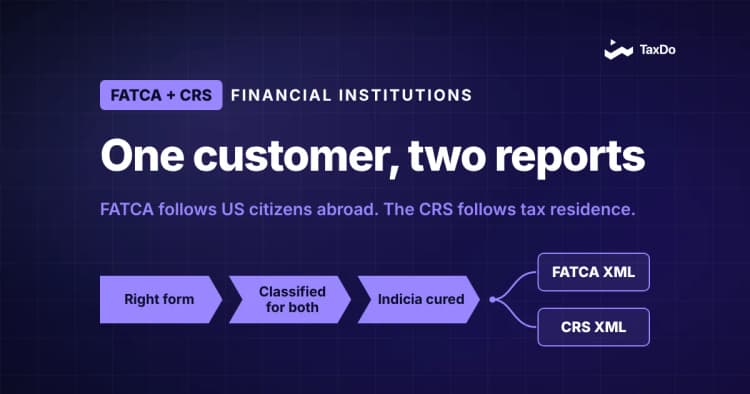
The Act implements the 2023 OECD amendments, carried into EU law by DAC8, and our CRS 2.0 guide for financial institutions explains what they contain. It applies for the first time to calendar year 2026, so the first return under it is due to the Finnish Tax Administration (Verohallinto) by the end of January 2027 (s. 104).
The failure point is the account opened without a form. Section 97 is new in Finnish law (HE 84/2025): where it applies, a missing self-certification now has a deadline, and the remedy is to close the account (s. 97(2)).
There are two ways to meet the Finnish rules. The first relies on the section 97 exception where its sector qualifies and tracks the 90-day clock account by account. The second completes and tests the self-certification while the customer is still onboarding, so no clock starts. One manages closures; the other avoids them.
01 · Finland CRS 2.0 at a Glance
| Point | Position as at 28 October 2026 |
| Self-certification | At opening, checked for reliability against AML/KYC records (s. 86); if impossible, within 90 days or the account is closed (s. 97) |
| Legal basis | Act 1042/2025 on the reporting obligation of reporting financial institutions; Act on Assessment Procedure (VML), s. 17 c |
| In force | 1 January 2026, first applied to calendar year 2026 (s. 107) |
| Report | By the end of January after each calendar year, electronically, including a nil report (s. 104) |
| Authority | Verohallinto (Finnish Tax Administration) |
| Records | At least six years from the end of the calendar year concerned; for a closed account, six years after the year of closure (s. 103) |
| Penalties | Default penalty (laiminlyöntimaksu) of up to EUR 2,000, 5,000 or 15,000 for late, defective or missing returns or neglected obligations (VML s. 22 a) |
Our regulatory compliance engine readies Finnish banks, funds and e-money institutions for CRS 2.0 from Day 1. It gathers each self-certification at opening, validates the TIN, runs the reliability and indicia checks, resolves indicia automatically instead of by your team, and prepares the validated CRS report, with zero remediation.
02 · Expanded Scope Under CRS 2.0
The Act widens the definition of a depository account to include an account holding all of a customer’s electronic money, and an account holding central bank digital currency for a customer (s. 27). An e-money account is an excluded account, a special e-money depository account, where it holds all the customer’s e-money and its rolling 90-day end-of-day average balance did not exceed USD 10,000, or the euro equivalent, on any day of the calendar year (ss. 45 and 51).
Those e-money and central bank digital currency accounts are pre-existing if held on 31 December 2025, and new if opened from 1 January 2026, as are the accounts of an entity that becomes a reporting financial institution under the Act (ss. 37 and 38). Every other account keeps the original 2015 and 2016 reference dates.
The return adds fields (s. 105): whether each holder and controlling person gave a reliable self-certification, whether the account is joint and how many holders it has, the account type, whether it is pre-existing or new, the role of each reportable controlling person, and the role of an equity interest holder in an investment entity that is a legal arrangement. The Act also applies to exchanges under the CRS multilateral agreement and its Addendum, which Finland signed on 26 November 2024 (s. 1).
03 · Key Challenges for Finnish Financial Institutions
For a new individual account the institution must obtain, at opening, a self-certification that establishes every jurisdiction of residence, and confirm its reliability against the information obtained at opening, including AML/KYC documentation; if it shows residence in a reportable jurisdiction, the account is reportable (s. 86). Section 97 is the exception, and its cost: the 90-day limit, then closure.
The second challenge is the existing book. Institutions maintaining e-money or central bank digital currency accounts, and entities newly brought in by the Act, must apply the pre-existing account procedures to those accounts held on 31 December 2025 (s. 37), with no reporting history to draw on.
The third is the TIN. For a new account, the return carries a TIN for each residence, unless that jurisdiction issues none (ss. 105 and 106), and the institution checks it at onboarding, before the end-of-January deadline, not after.
04 · Practical Compliance Measures
Section 17 c of the Act on Assessment Procedure (verotusmenettelylaki, VML), as amended by Act 1043/2025, obliges a reporting financial institution to apply the due diligence of Chapter 2 of Act 1042/2025 and give Verohallinto the Chapter 3 information, or a statement that it had no reportable accounts.
Records of the steps taken and the information used are kept for at least six years from the end of the calendar year they concern, and for six years after the year of closure where an account is closed (s. 103). A new VML section 28 a treats an arrangement one of whose main purposes is to avoid the reporting or due diligence obligations as if the right form had been used.
Under VML section 22 a, Verohallinto can impose a default penalty (laiminlyöntimaksu) of up to EUR 2,000 for a late return or a minor error left uncorrected after a request, up to EUR 5,000 for a substantially incomplete or incorrect return or one given only after a request, and up to EUR 15,000 where no return is given at all, or where, intentionally or through gross negligence, a substantially false return is given or another obligation such as due diligence is substantially neglected.
05 · Two Ways to Meet Finland’s CRS 2.0
After opening, by hand
Where section 97 applies, institutions track each missing form by hand against a 90-day clock that runs from opening, and each day counts toward a closure; elsewhere the form is due at opening (s. 86).
At onboarding, from Day 1
TaxDo runs CRS 2.0 due diligence inside onboarding, in five steps.
Step 1 · Collect the self-certification. Guided, jurisdiction-aware and signed digitally, with a passive entity’s controlling persons in the same flow.
Step 2 · Validate the identity. Every TIN checked in real time against official sources in 130+ countries; the business against registries in 120+.
Step 3 · Run forensic due diligence with Verify+. Our Verify+ forensic engine tests each self-certification against what the institution holds: 20+ checks on an individual, 30+ tax-native checks across eight areas on an entity.
Step 4 · Cure the gaps, without the compliance team:
4a · New accounts. Discrepancies resolved in the session, while the customer is onboarding.
4b · Existing accounts. One click starts remediation for the whole cohort: holders answer guided questions through a link in your brand, Verify+ checks each answer, and each case closes with a signed self-certification and an audit-ready certificate.
Step 5 · Prepare the report. Schema-validated CRS XML, prepared and validated for your institution to submit to Verohallinto. Our team can also submit it on your behalf on request, as an additional service.
From Day-1 self-certification to CRS XML reporting, with zero remediation.
Our CRS 2.0 compliance software · Solutions for financial institutions
Where this sits, and what it does not touch
It runs beside your KYC provider and core banking system. The reporting obligation, and the responsibility for what is reported, stays with your institution, including where TaxDo submits the report on its behalf at its request. TaxDo runs the due diligence and prepares and validates the report.
06 · Preparing for 2026: Timeline and Action Points
26 November 2024
Finland signs the Addendum to the CRS multilateral agreement.
28 November 2025
Acts 1041/2025 to 1044/2025 are given, implementing DAC8; published on 1 December.
1 January 2026
Act 1042/2025 applies; e-money and central bank digital currency accounts opened from today are new accounts.
31 January 2027
End of the month by which the first return under the Act, for 2026, is due.
Act 1041/2025, passed with it, applies the crypto-asset rules to service providers; see our Finland CARF article and, for the EU picture, our DAC8 article and DAC8 compliance software.
07 · Related Reading
Framework articles: CRS 2.0 compliance for financial institutions · DAC8 under CRS 2.0 and CARF · Self-certification under CRS 2.0, DAC8 and CARF · Finland and CARF · CRS 2.0 in Switzerland · Germany, CRS 2.0 and DAC8 · CRS 2.0 for French banks
Product: Regulatory compliance engine · Day 1 onboarding validation · TIN lookup · Business registry check