 Get in touch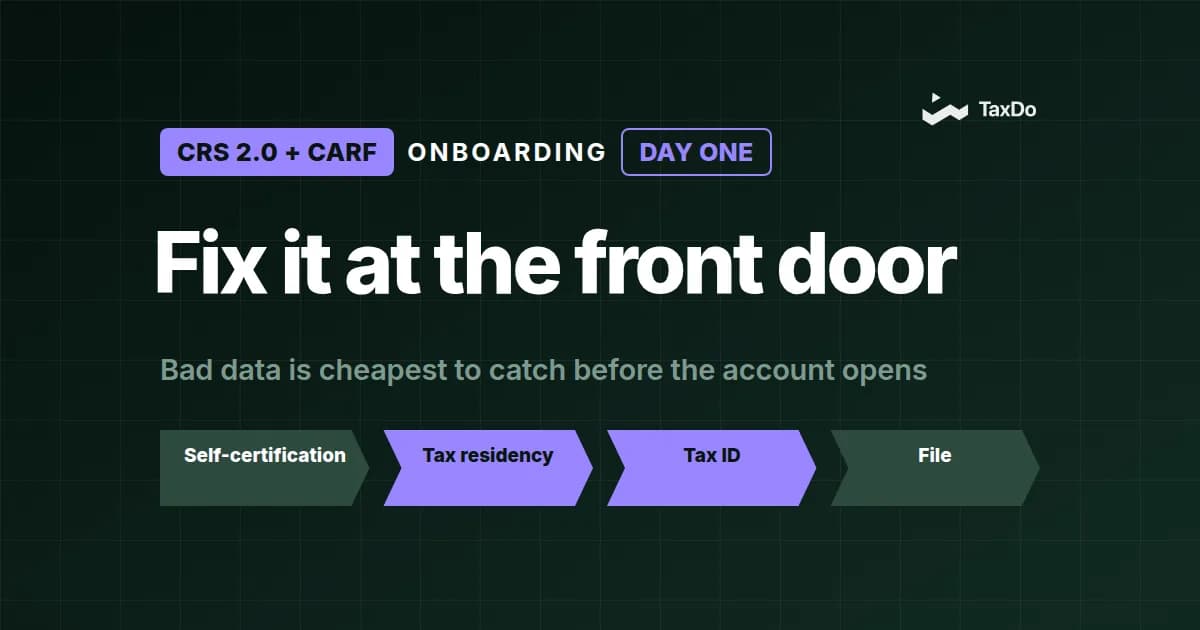
For regulated financial institutions, the definition of a “New Account” has fundamentally changed.
Banks, Custodians, Electronic Money Institutions (EMIs), and Crypto-Asset Service Providers (CASPs) are entering a regulatory environment in which onboarding itself is a formal compliance control. Under the combined force of CRS 2.0, CARF, and DAC8, compliance no longer begins at reporting—it begins at the moment an account is created.
Historically, institutions operated on a “collect now, validate later” approach, relying on post-onboarding review and periodic remediation. Under the amended frameworks, that operating model is no longer legally defensible.
As a result, the regulatory Reasonableness Test has evolved into a strict Day-1 validation obligation. From 1 January 2026, institutions in early-adopter jurisdictions must ensure that tax residency data is validated, digitally signed, and evidentiary-ready as a condition of account operation.
Institutions planning to address data quality at the 2027 reporting deadline are already exposed to non-compliance.
The Embedded “Kill Switch” Reality
Although the first CRS 2.0 and CARF reports will not be filed until mid-2027, the operational mandate takes effect on Day-1 of 2026.
From that date forward, the familiar “30–90 day grace period” is no longer a buffer—it is a regulatory countdown.
Failure to validate a self-certification within the statutory window legally obligates institutions to restrict, suspend, or close accounts. Compliance is no longer a downstream function. It is now an upstream enforcement mechanism, embedding a regulatory “kill switch” directly into the customer lifecycle.
Day-1 compliance is no longer optional—it is structural.
Global Implementation Roadmap: The 2026 Rollout
The “Day 1” validation standard becomes law on the dates listed below.
EUROPE (EU & Non-EU)
- All 27 EU Member States (DAC8): January 1, 2026. First reports due in 2027 (9-month window).
- United Kingdom: January 1, 2026. First CARF reports due 31 May 2027.
- Switzerland: CRS 2.0 from 1 Jan 2026; CARF crypto provisions likely deferred (expected 2027 earliest per Federal Council/KPMG).
AMERICAS (Offshore & Onshore)
- Cayman Islands: January 1, 2026. Crucially, funds must appoint a Cayman-resident Principal Point of Contact (PPoC) by 31 Jan 2027.
- Canada: Draft legislation targeted 2026 (first CRS filings May 2027), but industry notes a potential deferral to 2027—monitor Finance Canada.
ASIA-PACIFIC & AFRICA
- Japan: January 1, 2026.
- South Africa: March 1, 2026 (Aligned with the tax year start).
- New Zealand: April 1, 2026.
The Data Gap: What Changes at Onboarding?
It is not just about “when”—it is about “what.” The scope of data collection has expanded significantly under CRS 2.0:
- New Roles: You must now capture specific roles for Controlling Persons (e.g., distinguishing “Senior Managing Official” from “Beneficial Owner”).
- Transitional Relief (Pre-Existing Accounts): Certain new CRS fields (e.g., controllingperson roles) are reportable only if available in electronically searchable data until 30 Jun 2028; plan remediation accordingly.
- Asset Classification: Distinct tracking for Specified Electronic Money Products (SEMPs) vs. CBDCs vs. Crypto-Assets to avoid misreporting.
- The “Coordination Rule”: Amended CRS allows you to “switch off” gross proceeds reporting if the same info is reported under CARF. If your system cannot map this, you will double-report and confuse your clients.
Why Most Compliance Stacks Will Fail
Most compliance tools were built for reporting output—XML generation, schema mapping, and filing support. They were never designed to solve the Onboarding or Back-Book problem.
CRS 2.0 and CARF do not fail at reporting. They fail at onboarding and remediation.
Without a Day-1 enforcement mechanism, institutions are left with:
- Missing or Invalid self-certifications
- Conflicting indicia (e.g., address vs. declared country) with no cure path
- Manual remediation programs that drain resources
- Audit exposure with no defensible evidence
Existing reporting tools cannot fix upstream data failure.
TaxDo defines the emerging category of Day-1 Compliance Infrastructure—purpose-built to enforce CRS 2.0 and CARF at the point of onboarding, rather than attempting to remediate compliance failures at reporting.
TaxDo: The Day-1 Compliance Infrastructure Layer
TaxDo is architected specifically for the Day-1 compliance reality of CRS 2.0 and CARF.
We do not just “collect forms.” We provide a compliance infrastructure layer that enforces forensic data hygiene at the moment an account is created—and continuously thereafter to ensure Day1 validity, unified remediation, and auditready evidence.
Unlike legacy reporting tools built for downstream XML reporting, TaxDo is purpose-built as an upstream compliance infrastructure layer, enforcing Day-1 onboarding controls, real-time validation, and zero-touch remediation by design to make your accounts audit-proof from the first second.
Fast-Track Outcomes:
- Day-1 Gate live in weeks — not months: From contract signature to a production-ready onboarding gate enforcing CRS 2.0 and CARF, with validated self-certifications, legally binding digital signatures, and audit-grade timestamps.
- Backbook remediated in days rather than months: Cut manual effort by up to 90%
1. The Day-1 Onboarding Gate (No Cert, No Service)
Launch in weeks. Implementation runs alongside existing CRS/CARF reporting stacks and does not require core system replacement.
Stop bad data at the door. Our white-label self-certification module integrates directly into your signup flow.
- Dynamic UX: Intelligent, guided user experience (no static forms or PDFs).
- Smart Entity Detection: Automatically handles complex entity, Controlling person classification, and FATCA compliance, including live GIIN validation.
- White-Label: Fully branded experience (your domain, branding, sender identity).
- TaxDo Sovereign Runtime: Run the full smart self-certification and zero-touch remediation platform on dedicated, single-tenant infrastructure deployed in the country of your choice—designed for maximum data privacy, regulatory comfort, audit defensibility and jurisdictional control.
- Legally Binding: Captures digital signatures with audit-grade timestamps.
2. Real-Time “Forensic” Validation
We don’t trust; we verify. TaxDo validates Tax Identification Numbers (TINs) in real-time.
- Global Official TIN Lookup: As the leading global TIN provider, we verify TINs in real-time via 125+ official tax authority sources (where available). No other compliance tool provides this level of direct verification.
- Global Syntax Engine: Comprehensive syntax validation rules for 205+ countries and all tax types where live calls aren’t possible.
- Indicia Forensics: Our engine silently scans for “Conflicting Indicia” (e.g., address vs. tax residency) and triggers a cure before the breach occurs.
3. Zero-Touch Back-Book Remediation
The largest CRS and CARF risk lies in the Pre-Existing Account base. TaxDo automates remediation end-to-end:
- 24-Hour Scan: Assess 10,000 to 1,000,000+ accounts instantly to identify missing data, wrong formats, or conflicting indicia.
- One-Click Campaigns: Launch targeted email/push remediation campaigns.
- Automated Curing: The user clicks, updates, and signs while the system validates all data in the background.
- Cost Reduction: Reduce manual remediation effort by up to 90%.
The Verdict: Audit Survivability
CRS 2.0 and CARF do not reward intent. They demand evidence. TaxDo’s architecture aligns with how regulators now assess compliance: continuous control, not post-filing remediation.
The platform is designed not just for compliance, but for audit survivability under CRS and FATCA. Every successful submission produces:
- A fully signed, timestamped, and verified self-certification
- A complete evidentiary audit trail
- Clear documentation of indicia detection and curing actions
This is Day-1 audit survivability by design.
Pick Your Path to Compliance
Day 1 is the point of no return. You have two options:
• Option A: The 24-Hour Scan. Request a gap assessment of your back-book to see your risk heatmap.
• Option B: Rapid Day-1 Activation. Deploy a production-ready onboarding gate/Zero Touch Remediation and move to live CRS 2.0 and CARF enforcement in weeks rather than months.
No rip-and-replace. No reporting vendor lock-in. TaxDo integrates alongside existing CRS and CARF stacks.