 Get in touch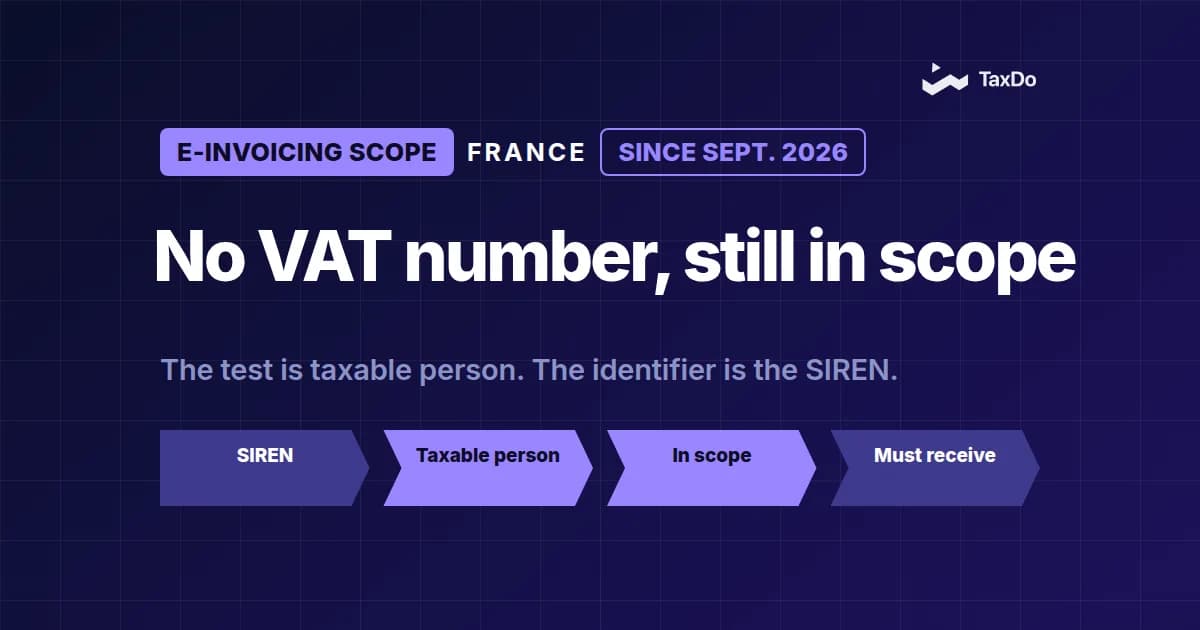
Sources last verified 16 September 2026. Every quotation below is taken from a French government publication, cited in full at the end.
The obvious way to work out which of your French customers are affected is to sort your ledger by VAT number. It is wrong, and wrong in the direction that costs money.
This article gives you the test that actually decides it, in the French administration’s own words, with the exclusions that actually apply and the penalties that follow. By the end you will be able to sort your French customer list correctly.
French law separates two ideas that English collapses into one, and the whole question turns on the difference.
| French term | What it means | Decides scope? |
| assujetti | A taxable person: anyone carrying on an independent economic activity on a habitual basis | Yes. This is the test |
| redevable | Someone who actually charges and remits VAT | No |
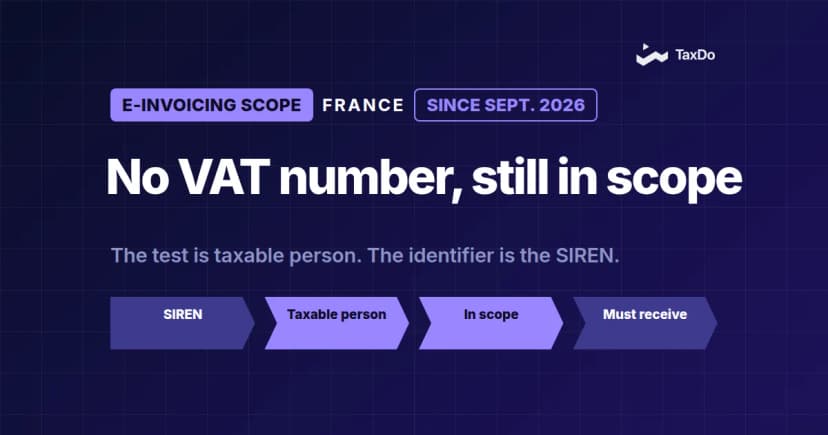
The French tax administration states it in one line: « La réforme s’applique à tous les assujettis à la TVA, qu’ils soient redevables ou non de la TVA. » The reform applies to every taxable person, whether or not they are liable for VAT.
The businesses this catches out
A micro-entrepreneur under the franchise en base charges no VAT, may show you no VAT number, and is fully in scope. The Ministry of the Economy is explicit: these businesses « ne sont pas redevables de la TVA. Cependant, elles restent assujetties à la TVA et sont donc soumises à la facturation électronique, en réception et en émission ».
So screening a customer list by “has a VAT number” or “charges VAT” silently drops every micro-entrepreneur, auto-entrepreneur and franchise-en-base business you sell to. Each of them has had an obligation to receive electronic invoices since 1 September 2026.
The identifier the reform actually runs on is the SIREN. It is the new mandatory mention on the invoice, it is how the national directory is keyed, and it is the unit used to decide which deadline a company falls under.
For the wider picture, the France VAT guide covers registration, the rate tiers and filing, and the French-language article on the annuaire covers how to check that a customer can actually receive what you send.
The timetable, and why receiving is the near-universal part
| Obligation | Who | From |
| Receive electronic invoices | Every business, any size | 1 September 2026 |
| Issue electronic invoices | Large and mid-cap (GE, ETI) | 1 September 2026 |
| Issue electronic invoices | SME, small and micro businesses | 1 September 2027 |
One conditional worth keeping: the reception obligation applies « dès lors que leur fournisseur a l’obligation de les émettre sous ce format », where the supplier is obliged to issue that way. For a supplier, the practical reading is that your SME customers cannot yet be required to issue, but they can already be required to receive. An invoice you send them today has to arrive.
Exempt from issuing is not exempt from receiving
There is a real carve-out, for businesses whose own operations are VAT-exempt under articles 261 to 261 E of the French tax code. It is narrower than it first appears, and it does only one thing.
It relieves them of issuing. It does not relieve them of receiving. The administration’s own worked example is a general practitioner or an osteopath, who « doit avoir choisi une plateforme agréée, dès le 1er septembre 2026, afin de recevoir les factures de ses fournisseurs d’énergie ou d’accès internet ».
If you supply exempt sectors, medical practices, schools, certain insurers, your customers there are still expected to receive electronically from you.
Two cautions. VAT-exempt in general is not this carve-out: exemptions resting on other articles, and operations taxed by option, are not covered. And no published list of exempt categories should be treated as exhaustive.
Who sits outside the obligation
Reception is universal among taxable persons established in France. It is not universal without qualification, and the exclusions turn on status and territory rather than size.
- Taxable persons not established in France. A foreign company with a French VAT establishment, however, carries the same obligations as a French one.
- Businesses established in Guyane or Mayotte, where VAT does not apply. Guadeloupe, Martinique and La Réunion are in scope.
- The overseas collectivities: Saint-Pierre-et-Miquelon, Saint-Barthélemy, Saint-Martin, New Caledonia, French Polynesia, Wallis and Futuna, and the French Southern Territories.
- Non-taxable associations, and passive holding companies.
What it costs to be wrong
Penalties run per invoice and per failure. Fifty euros for each invoice not issued in the required electronic form, capped at fifteen thousand euros a calendar year, with a first infringement unpunished. Five hundred euros for not having chosen a reception platform, applied three months after a formal notice, and rising by a further thousand euros for each subsequent three-month period.
A start-up period of enforcement restraint has been announced. The administration has been unusually direct about what it is not: « Cette approche ne constitue ni un report ni une suspension de l’obligation. » The calendar stands, and no end date for the restraint has been published.
What this means for a supplier’s customer data
Three practical consequences follow, and they are the reason this question matters commercially rather than academically.
VAT status cannot be used as a filter. A customer with no VAT number may be fully in scope, so any segmentation built on VAT registration will be wrong for a large share of French businesses, and wrong invisibly.
Scope should be reasoned from the SIREN, because that is what the reform operates on and what the directory is keyed by.
And scope is only the first question. A customer being in scope does not tell you whether their address is registered, active, or reachable today. That is a separate check, and it is the one that decides whether an invoice arrives.
Next: verify a French customer can receive your e-invoice
Check your French customer list against the real position Send us a sample of French customer identifiers and we will show you, on your own data, which are in scope, which addresses resolve, which are active and which would fail today. Request a demo · E-invoicing compliance