 Get in touch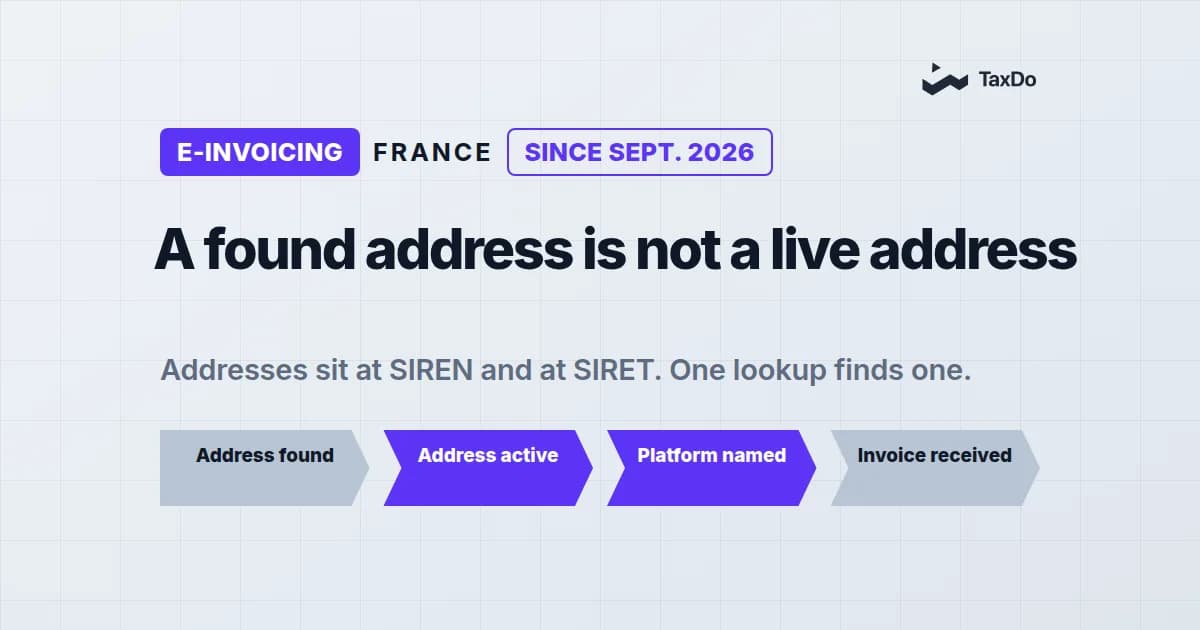
Sources last verified 16 September 2026. Every figure below traces to an official publication or to a stated measurement.
A paper invoice with a wrong address comes back. An electronic invoice sent to an address that exists, but is not the right one, does not.
It is accepted, timestamped, and goes quiet. You may not find out that week. You find out around day forty-five, when the payment has not arrived and the invoice has become a collections problem rather than a document you could have resent. The cost was never the invoice. It is the working capital and the recovery time.
This article shows you exactly how to check. By hand, free, for one customer. And automatically, across your whole ledger: the billing address, the accredited platform that serves it, the document formats it accepts, and an alert the moment a customer’s status changes. You will know, before you send, whether the invoice will arrive.
If you sell into France, this became your problem on 1 September 2026, whether or not your own country has a mandate.
What has to be true before you send
For an invoice to arrive, three things must be true at the same time. Most checks confirm the first and stop.
- The address exists and the customer is listed in the directory.
- The address is active. The French directory treats presence and activity as separate facts, and shows them as separate fields.
- The receiving platform accepts the document type you send. Interoperability between accredited platforms is guaranteed by the reform. The document types a given platform accepts are a property of that platform.
There are two ways to get those three answers. The first is free and manual, through the public portal: fine for one customer, occasionally, and the exact method is set out further down. The second is automated, and it is the only one that survives a customer ledger.
For a supplier sending a handful of French invoices a month, the public route is adequate: free, no account, and it answers the basic question.
The two ways to get those answers
By hand, one customer at a time
The French directory is consultable free from the public portal, with no account and no password. You enter a customer’s SIREN, SIRET or company name, clear the anti-robot check, and read the record: the structure, its establishments, whether an accredited platform is attached, and the active billing addresses. It answers the first question well, and it costs nothing.
But it is one company at a time, in a browser, behind a bot check, with no programmatic access and no alert when anything changes. Two hundred customers, checked at two levels each, is a day of work that is stale within the quarter.
Automatically, across the whole ledger
E-Invoicing Address+ · E-Invoicing Address Verification & Monitoring.
TaxDo covers French business electronic invoicing addresses nationwide, drawn from authorized sources and several combined databases, through an API and a dashboard. It runs in four steps, in this order, because each one needs the one before it.
Step 1 · Validate the identifier. VAT, SIREN or SIRET. First confirm the number you hold is correct, because everything that follows depends on it.
Step 2 · Find the address. From that number, resolve the customer’s electronic billing address. Across all four levels, SIREN, SIRET, routing code and suffix, without missing one.
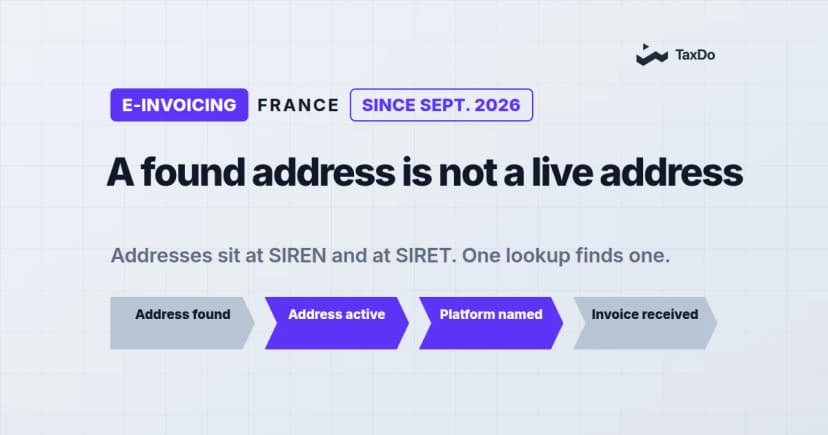
Step 3 · Confirm the address is live and ready to receive your invoice. Three answers that arrive together, at the moment you send: the address is live and able to receive this invoice today, which the directory records as an “active billing address”; which accredited platform serves it, by name; and which document types that platform accepts.
Step 4 · Monitor over time. Because an address that is valid today can be dead in two months. In two forms:
4a · Before each submission. A check confirming this customer is able to receive this invoice.
4b · Scheduled validation. Weekly, monthly or quarterly, across the whole customer ledger. The system detects status changes and alerts you before you send, not after.
The point is simple. Rather than hoping your customer receives the invoice, you know the address is validated, live and reachable before you send.
What France actually requires
From 1 September 2026, every business established in France that is a taxable person must be able to receive invoices electronically, regardless of size, « dès lors que leur fournisseur a l’obligation de les émettre sous ce format », meaning where their supplier is obliged to issue in that format.
Issuing obligations are staged. Large and mid-cap companies from the same date, small and micro businesses from 1 September 2027.
What is compulsory is not a network. It is the use of an accredited platform, a plateforme agréée, under article 289 bis of the French tax code. The French administration renamed these from plateforme de dématérialisation partenaire (PDP), a term still visible across official pages.
Routing is handled by a national directory, the annuaire de la facturation électronique, operated by the DGFiP and the AIFE and opened on 18 September 2025. It references every public body and every private entity identified as a taxable person in France, with the addresses at which each wishes to receive invoices. Your customer’s platform reads it. So, in effect, does yours.
Two related pages answer the questions this one does not. The France VAT guide covers registration, the rate tiers and the CA3 filing cycle. And the French-language companion to this article sets out the same checks for suppliers established in France, in the vocabulary the French market itself uses.
A word on who is in scope
One thing to settle before the rest, because getting it wrong corrupts a customer list quietly. French scope turns on being a taxable person, not on holding a VAT number. A micro-entrepreneur who charges no VAT is still in scope and has had an obligation to receive since 1 September 2026.
So screening French customers by “has a VAT number” drops businesses that are covered. The identifier the reform runs on is the SIREN. Businesses whose own operations are VAT-exempt are relieved of issuing, never of receiving.
The full scope rules, with the official wording and the exclusions
Why a Peppol lookup does not answer this
Most international billing teams already have a Peppol participant lookup, and reasonably assume it covers France. It does not, for two reasons that are worth separating.
France did not adopt Peppol as its legal channel
The French tax administration is explicit. Comparing France with Belgium, where Peppol is the official transmission channel, its own guidance says the network is « facultatif en France ». Optional in France. The DGFiP did become the Peppol Authority for France in July 2025, and accredited platforms may connect through Peppol. But the legal requirement is the accredited platform, and the authoritative addressing record is the French national directory.
Directory publication is voluntary, and the coverage shows it
OpenPeppol states the position plainly: “the publication of Peppol participant information in an SMP happens on a voluntary basis… not all business entities are listed in the Peppol Directory”. Absence from the directory therefore proves nothing about a company. It also means a lookup that returns nothing has not answered your question.
We measured what that means in practice. In a population-proportional sample of 240 active French businesses, drawn across 77 departments and 209 communes on 16 September 2026, we queried the public Peppol Directory for each company’s SIREN.
| French businesses sampled | Found in the public Peppol Directory |
| All 240 companies | 22.5% (95% confidence interval 17.7 to 28.2%) |
| No declared headcount | 16.8% |
| 1 to 9 employees | 45.5% |
| 10 to 49 employees | 53.8% |
| Large enterprises | 83.3% |
| Associations | 0 of 18 |
Read that carefully, because the honest reading is the useful one. It does not mean 77.5% of French companies cannot receive an e-invoice. Publication is voluntary, so an unlisted company may be perfectly reachable. What it means is that for roughly three quarters of French businesses, a Peppol directory lookup returns no answer at all, and the gap is widest among the small companies that make up the tail of most sales ledgers.
There is a further limit. The two fields that decide whether a French invoice lands, adresse de facturation active and plateforme agréée rattachée, have no equivalent in a Peppol response. They can also legitimately disagree with each other, which is the subject of the next section.
A Peppol lookup answers network reachability. It does not answer French regulatory addressing state. Those are different questions, and only the second one determines whether your invoice arrives.
Two traps in the French record
One lookup is not enough to be correct
French billing addresses exist at four levels: SIREN, SIREN_SIRET, SIREN_SIRET_routing code, and SIREN_suffix. Routing codes sit beneath the SIRET; suffixes sit beneath the SIREN. Neither is created by default.
The consequence is stated in the official documentation: « Pour retrouver l’intégralité des adresses actives d’une structure privée, il est nécessaire de consulter les informations à la fois au niveau du SIREN et de ses SIRET. » To find all of a private company’s active addresses you must consult both the SIREN level and its SIRET levels.
Check only the SIREN and you may read back a perfectly valid address while missing the one that applies to the establishment you are invoicing. The error is silent, and it looks like success.
An expired address disappears rather than failing
A company can show an accredited platform attached while its billing address is not yet active, because the billing line is dated to take effect later. And an address whose validity has lapsed is simply no longer displayed. It does not turn red. It is not flagged.
So a customer you verified in September can be wrong in November, because they restructured or moved reception from SIREN level to SIRET level. The annuaire will not tell you. A one-time check produces confidence with an expiry date on it.
See it against your own customer list Send us a sample of French customer identifiers and we will show you, on your own data, which addresses resolve, which are active, which platform receives them and which would fail today. Request a demo · E-invoicing compliance · Talk to the team