 Get in touch
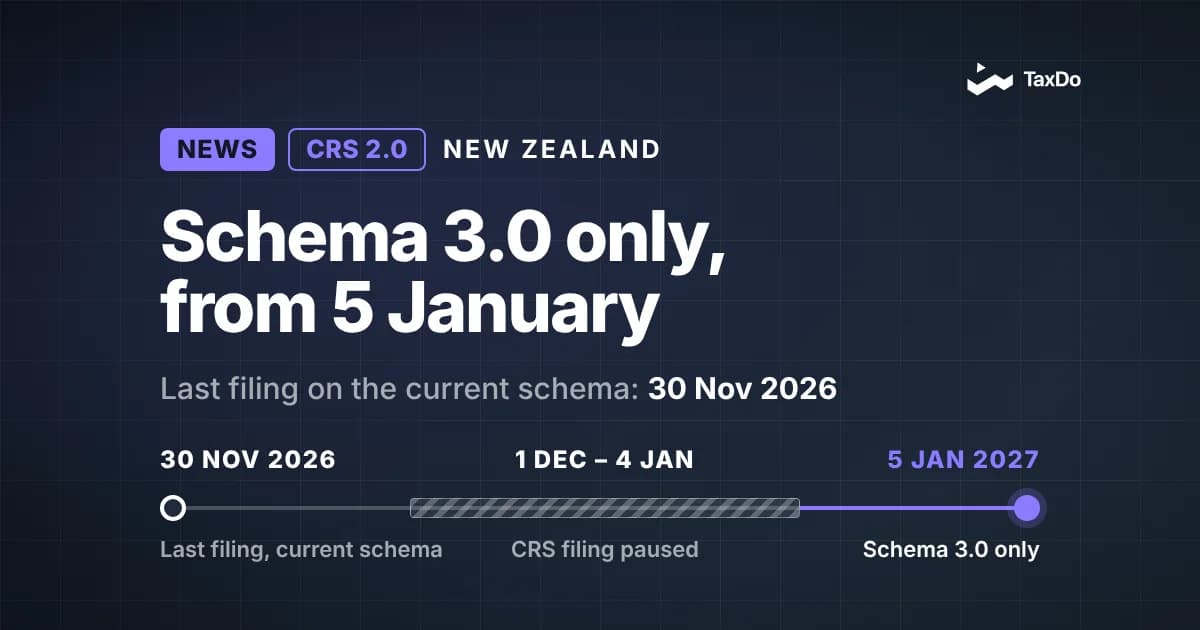
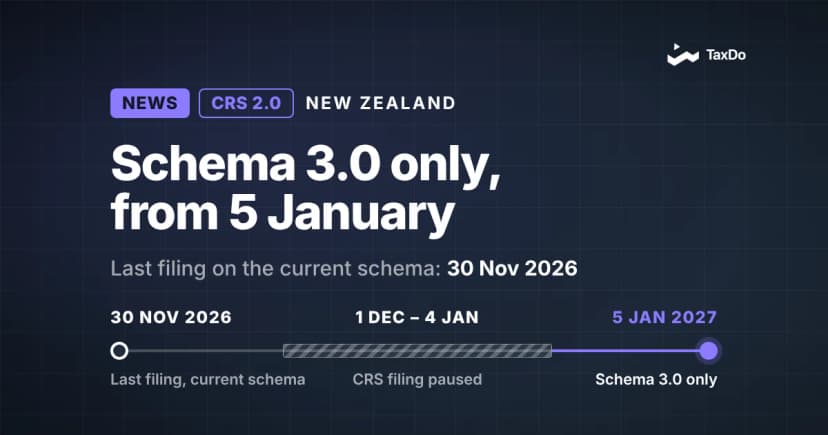
30 November 2026 is the last day Reporting New Zealand Financial Institutions can file CRS reports on the current schema; from 5 January 2027 Inland Revenue accepts CRS filings in schema 3.0 only.
New Zealand’s Inland Revenue (Te Tari Taake) set out the cutover in a notice dated 27 October 2026. CRS filing in myIR will be unavailable from 1 December 2026 to 4 January 2027 while Inland Revenue updates its systems.
01 · What changed
In a notice headed “CRS reporting changes are coming”, Inland Revenue said the OECD had published a third version of the CRS XML schema and that “[a]ll CRS information exchanges must comply with it from 1 January 2027”. The OECD released the amended CRS XML schema and its user guide in October 2024, for the CRS as updated in 2023.
The schema follows the amended CRS, which took effect in New Zealand on 1 April 2026 under the Taxation (Annual Rates for 2024–25, Emergency Response, and Remedial Measures) Act 2025.
02 · Key dates
| Date | What happens | Source |
| 30 November 2026 | Last date to submit CRS reports using the current schema | Inland Revenue notice, 27 Oct 2026 |
| 1 December 2026 to 4 January 2027 | All CRS filing options unavailable in myIR | Inland Revenue notice and key dates page |
| 1 January 2027 | Schema 3.0 must be used | Inland Revenue notice and key dates page |
| 5 January 2027 | Filing resumes in myIR in schema 3.0; early filing for the 2027 year starts again | Inland Revenue notice |
| 31 March 2027 | End of the first reporting period under the amended CRS | Inland Revenue amendments page and key dates page |
| 30 June 2027 | Last day to submit that period’s CRS information | Inland Revenue key dates page |
The notice ties the 1 January 2027 date to “all CRS information exchanges”. Because CRS filing in myIR is unavailable until 4 January inclusive, 5 January 2027 is the first day a Reporting NZFI can file in schema 3.0.
03 · Who is affected
The change applies to every Reporting New Zealand Financial Institution (Reporting NZFI) that files CRS information with Inland Revenue. Inland Revenue says some products and accounts that were not reportable before may now have to be reported, and that more information may have to be collected and reported, including new mandatory data elements.
04 · What it means in practice
The online form in myIR gains new fields, a new version of the Excel upload template will be issued, and an XML upload will be accepted only in schema 3.0 after the cutover. Inland Revenue warns that new validations may identify data quality issues, resulting in filing errors that need to be corrected before submission.
After the cutover, corrections and additional information for periods ending 31 March 2026 and earlier must be submitted in schema 3.0. Inland Revenue says the new fields can be populated using transitional code values, which the notice does not list. The notice gives 30 November 2026 as the final date “reports” can be submitted using the current schema; it does not mention corrections separately before the cutover.
05 · What to do now
1. Submit any report on the current schema by 30 November 2026. This is not a new due date: the annual due date remains 30 June.
2. Plan around the pause in CRS filing in myIR from 1 December 2026 to 4 January 2027.
3. XML filers: test schema 3.0 files with the CRS XML file validation service in myIR. Excel filers: use the new template once Inland Revenue issues it.
4. Check that systems hold the new mandatory data elements, and that products and accounts brought into scope by the amendments are identified.
5. Send questions on the CRS or the new schema to Inland Revenue through the email link in its 27 October notice.
06 · The wider picture
The same 2025 Act gave effect to the Crypto-Asset Reporting Framework: Inland Revenue says New Zealand-based Reporting Crypto-Asset Service Providers must apply it from 1 April 2026, with a first report due by 30 June 2027; our CARF guide sets out the framework. Our CRS 2.0 guide covers the amended standard, and the self-certification guide covers the data each account now needs.
How TaxDo helps
Our regulatory compliance engine collects and checks the self-certification, validates TINs against official sources and resolves indicia, so new accounts carry the new data elements from onboarding. It produces CRS XML validated against schema 3.0, ready for your institution to test and submit; on request, our team can also submit it on your behalf as an additional service, while the reporting obligation stays with your institution. See CRS compliance for financial institutions.