 Get in touch
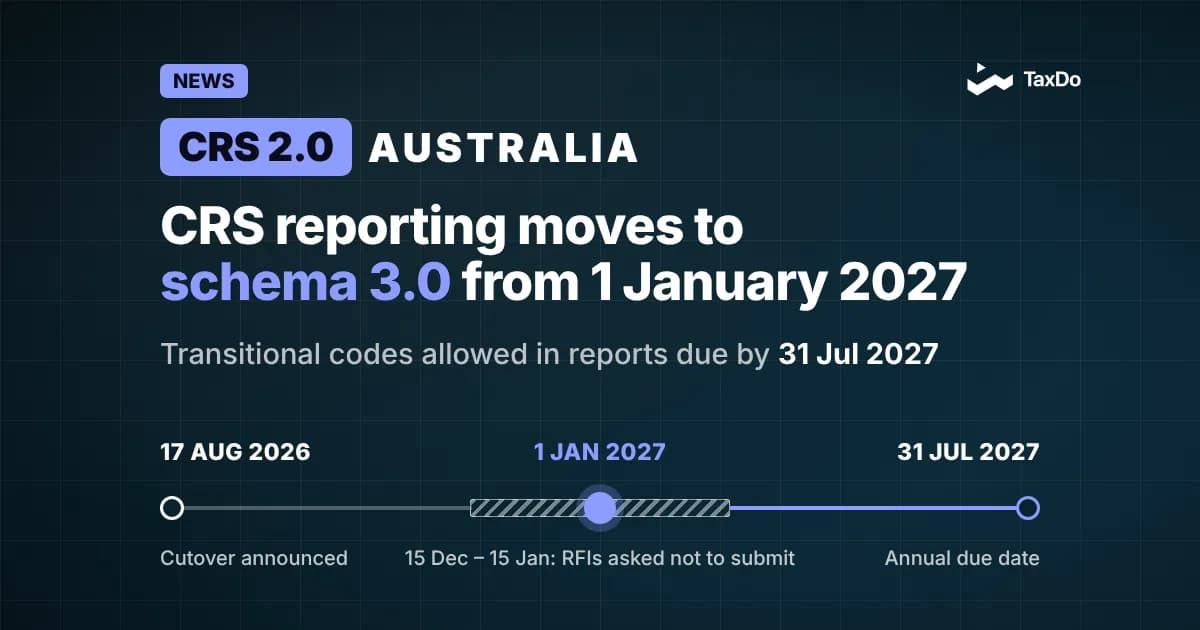
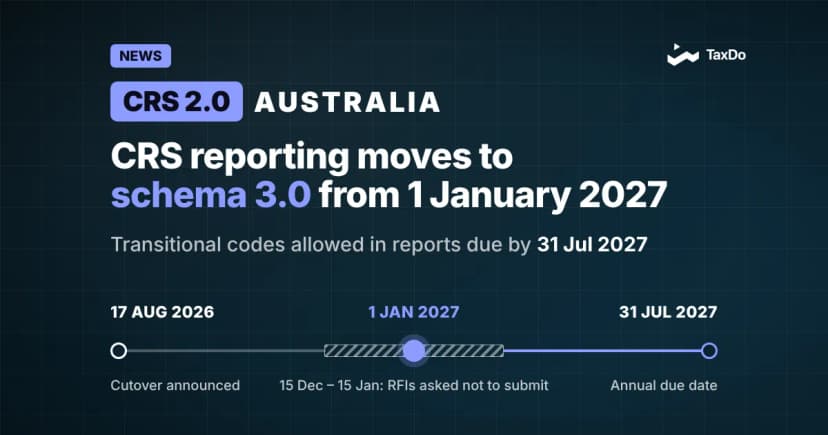
From 1 January 2027 the ATO will accept CRS files in schema 3.0 only, with transitional “not reported” codes allowed in reports due by 31 July 2027.
The Australian Taxation Office (ATO) will reject CRS files on schema version 2.0 from 1 January 2027, under a hard cutover announced on 17 August 2026. Version 0.3 of its draft CRS 2027 specification was published on 22 October 2026. The ATO has asked Reporting Financial Institutions (RFIs) not to submit files from 15 December 2026 to 15 January 2027.
01 · What changed
In its software developers notice of 17 August 2026, the ATO said that from 1 January 2027 files submitted using Version 2.0 “will be rejected”. The OECD’s Amended Common Reporting Standard XML Schema user guide documents schema 3.0.
The version 0.3 package adds a rule that each DocRefID in the payload must be unique and updates the rule limiting each lodgment to one CrsBody element. The ATO’s CRS reporting page (last updated 6 October 2026) sets out the transitional codes.
02 · Key dates
| Date | What happens | Source |
| 17 August 2026 | Cutover announced; schema 3.0 testing available in the External Vendor Testing Environment (EVTE) | ATO Software Developers notice |
| 15 December 2026 to 15 January 2027 | RFIs asked not to submit CRS files | ATO CRS reporting page |
| 1 January 2027 | Schema 3.0 takes effect; Version 2.0 files rejected | ATO Software Developers notice |
| 31 July 2027 | Annual due date; transitional codes allowed in reports due by then | ATO CRS reporting page |
The window is a request: RFIs “are also requested not to submit files” while system updates are deployed. The ATO does not say what happens to a file lodged in that window.
03 · Who is affected
The cutover applies to every RFI lodging CRS reports; the ATO says RFIs include banks and other deposit-taking institutions, custodial institutions, investment entities and specified insurance companies. A trust that is an RFI still reports its own details, including its TFN or ABN, not the trustee’s.
04 · What it means in practice
The ATO says the new data elements are mandatory: an RFI must either report the data or use the transitional codes. For reports due by 31 July 2027 the codes are CRS900 (Account Holder self-certification status), CRS800 (Controlling Person type), CRS1000 (Controlling Person self-certification status), CRS1100 (account type) and CRS1200 (Pre-existing Account or New Account), each meaning “not reported”. The OECD user guide describes each as available “as a transitional measure, in order to facilitate interoperability with the previous version of the schema”, notably for corrections.
The ATO says RFIs should not use the new Account Number Type code OECD606 (Specified Electronic Money Product), which has no transitional code. Not using CRS1100 activates additional ATO validation rules on consistency between Account Type, Account Number Type, Equity Interest Type and Payment Type. The August notice adds rules on schema versioning and mandatory contact information; neither these nor schema 3.0 apply to production files before 1 January 2027.
The ATO’s pages state no exception for corrections to periods reported on Version 2.0, nor whether transitional codes may be used in them. The v0.3 package lists further rules for DDProcedure, the Pre-existing or New Account field, as “[d]ependent on legislation review and release”.
05 · What to do now
1. Plan any remaining Version 2.0 lodgment, including corrections, around the 15 December to 15 January window and the 1 January 2027 cutover.
2. Developers and in-house XML producers: test against the v0.3 package in the EVTE, after registering with the ATO’s Digital Partnership Office.
3. For reports due by 31 July 2027, decide for each new data element whether to report it or use its transitional code, and leave out OECD606.
06 · The wider picture
Treasury’s exposure draft, on which consultation closed on 28 October 2026, would incorporate the amendments in the OECD’s 2023 update to the Common Reporting Standard, with 1 January 2027 as the effective date of the amended CRS. Its amendments to Subdivision 396-C would apply to the 2027 calendar year and later. From the later of 1 January 2027 and commencement, the one-penalty-unit penalty for failing to obtain a self-certification would also cover failing to validate one or to act on a change in circumstances. The draft would provide a framework to introduce the OECD’s Crypto-Asset Reporting Framework, which our CARF guide sets out.
Our CRS 2.0 guide covers the amended standard and the self-certification guide the self-certification data it requires. New Zealand’s Inland Revenue is also moving CRS filing to schema 3.0.
How TaxDo helps
Our regulatory compliance engine collects and checks the self-certification, validates TINs against official sources and resolves indicia, so new accounts carry the new data elements at onboarding. It produces CRS XML validated against the OECD schema 3.0, ready for your institution to test and lodge, while the reporting obligation stays with your institution. See CRS compliance.