 Get in touch
Sources last verified: 28 October 2026
Official sources cited at the end of this page.
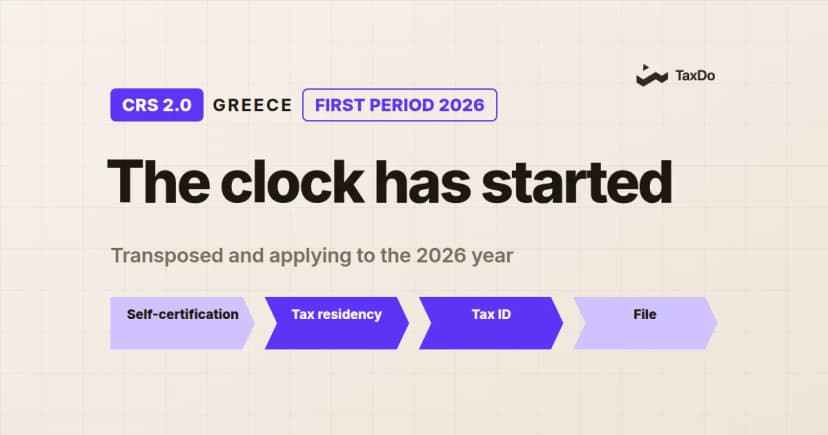
Four and a half months separate the start of Greece’s amended CRS from the law that enacts it. Law 5301/2026, published in the Government Gazette on 15 May 2026, rewrites the financial account rules in Annex I of Law 4170/2013 to transpose the EU’s DAC8, and its article 127 makes that part apply from 1 January 2026. Greek reporting financial institutions are therefore already in the first reporting year of CRS 2.0.
The changes reach the account opening form, the data model and the year-end return: e-money and central bank digital currency accounts come into scope, each return now states whether a valid self-certification was obtained and the role of every controlling person, and an e-money account escapes reporting only if its 90-day average balance stays at or below USD 10,000 all year.
Penalties under the Tax Procedure Code run from €100 for a late filing to €5,000 after an audit, most of them per reportable account, and double on a repeat breach.
There are two ways to meet the Greek rules. One gathers the missing self-certifications and controlling-person roles before the first amended return, account by account. The other collects and checks them at account opening, so the 2026 return is built from records that are already complete. Only the second keeps the gap from growing with every new account.
01 · Greece CRS 2.0 at a Glance
| Point | Position as at 28 October 2026 |
| Law | Law 4170/2013, Annex I, as amended by article 20 of Law 5301/2026 (Government Gazette A 74, 15 May 2026) |
| Applies from | 1 January 2026 (Law 5301/2026, art. 127(2)) |
| Authority | Independent Authority for Public Revenue (Ανεξάρτητη Αρχή Δημοσίων Εσόδων, AADE) |
| New in scope | Accounts holding e-money or central bank digital currency for customers |
| E-money exclusion | 90-day rolling average balance not above USD 10,000 on any day of the year |
| New data | Valid self-certification obtained or not; controlling-person roles; joint accounts; account type; new or pre-existing |
| Transitional | Roles on reportable accounts held on 31 December 2025 only where electronically searchable, for periods ending by 2027 |
| Exchange | Within nine months of the year end (Law 4170/2013, art. 9(2)(b)) |
| Penalties | €100 to €5,000, most of them per reportable account, doubled on repeat (Tax Procedure Code, art. 59(1), (3)) |
| Crypto-asset providers | Report under DAC8 (Annex VI), not the CRS |
Our regulatory compliance engine builds each Greek account’s CRS 2.0 record at opening. It collects and checks the self-certification, runs the TIN, reasonableness and other required due diligence checks, resolves indicia automatically instead of by your compliance team, and prepares the validated return, with zero remediation.
02 · What CRS 2.0 Changes
The OECD amended the CRS together with its new crypto-asset framework, published on 8 June 2023. Within the EU, those changes reach member states through Council Directive (EU) 2023/2226 (DAC8), which amends the CRS rules of the administrative cooperation directive alongside its crypto-asset rules. In Greek law, the result sits in Annex I of Law 4170/2013.
Four changes matter most to a Greek institution. E-money and central bank digital currency held for customers become depository accounts. The return gains data on each account and its holders. For pre-existing accounts, the institution must make every reasonable effort to obtain the TIN and date of birth whenever Law 4557/2018 requires the client information to be updated, not only on a remediation campaign. And gross proceeds that the same institution reports under DAC8 need not be reported again under the CRS, unless it elects otherwise.
03 · Greece’s Regulatory Roadmap
The CRS reached Greek law when Law 4378/2016 wrote DAC2 into Law 4170/2013, which transposes the EU’s administrative cooperation directive, and Greece ratified the OECD agreement on automatic exchange by Law 4428/2016. Law 5301/2026 transposes both DAC8 and the 2025 amendment, Directive (EU) 2025/872, and AADE’s circular Ο.3023 of 27 May 2026 notifies Part A of the law, with its entry-into-force article. Greece signed the Addendum to the CRS agreement, which carries the amended CRS into exchanges with non-EU partners, on 19 November 2024.
The law arrived after its start date: the transposition deadline was 31 December 2025, and the Gazette published Law 5301/2026 on 15 May 2026 with Part A applying from 1 January 2026. AADE publishes an informational list of reportable jurisdictions each year; the list posted in May 2026 covers information for 2025 and states that, under decision ΠΟΛ 1130/2017, the filing deadline for that information expired on 30 June 2026. The decision sets 30 June of each year; AADE had not announced a different date for the first amended return by 28 October 2026.
04 · Who Falls Under CRS 2.0 in Greece
Depository Institutions
Banks remain the core. The amended definition also covers an entity that holds e-money or central bank digital currency for customers, so an e-money institution’s customer accounts become depository accounts. An e-money account is excluded only if its rolling 90-day average end-of-day balance did not exceed USD 10,000 on any day of the calendar year (Annex I, Section VIII(C)(17)(η)).
Custodial Institutions
Custodians report as before. Gross proceeds from a sale or redemption need not be reported to the extent the same institution reports them under DAC8 (art. 9ΑΔ), unless it elects otherwise for a clearly identified group of accounts (Section I(F)).
Investment Entities
Funds and managers report equity and debt interests, and for an investment entity that is a legal arrangement, such as a trust, the return now states the role by which each reportable person holds the equity interest (Section I(A)(6A)).
Specified Insurance Companies
Insurers issuing cash value insurance or annuity contracts report as before, with the same new data on holders and controlling persons.
Crypto-Asset Service Providers (CASPs)
A crypto-asset service provider does not report its exchange services under the CRS. Law 5301/2026 adds Annex VI for crypto-asset reporting under DAC8, with its own penalties in article 59(10) and (11) of the Tax Procedure Code; our Greece CARF and DAC8 article covers those rules.
Passive Non-Financial Entities
For a passive entity, the institution identifies controlling persons from its anti-money-laundering records and now reports the role by which each is a controlling person, together with whether each gave a valid self-certification (Section I(A)(1)(b)).
05 · How Reporting Will Operate
For each reportable account, the return carries the holder’s name, address, residence, TIN and, for an individual, date and place of birth; whether the holder gave a valid self-certification; for entities with reportable controlling persons, the same data for each of them and their roles; whether the account is joint and how many holders it has; the account number, its type, and whether it is pre-existing or new; and the balance and payments (Section I(A)).
Institutions register and submit through AADE’s automatic exchange portal, listed on its CRS/DAC2 page; the page posted a new validator manual and a foreign TIN validation tool in June 2026. AADE then exchanges the information within nine months of the end of the calendar year.
| Breach (per reportable account unless noted) | Fine | Tax Procedure Code |
| Late filing | €100 | art. 59(1)(a) |
| Information omitted, incomplete or inaccurate | €300 | art. 59(1)(b) |
| No response to an AADE request in time | €1,000 | art. 59(1)(c) |
| Non-cooperation in an audit, or reporting and due diligence rules not followed (not stated per account) | €2,500 | art. 59(1)(d) |
| Reporting obligations not met after an audit | €5,000 | art. 59(1)(e) |
| Repeat breach | Double; quadruple on a further repeat | art. 59(3) |
A correction or completion made voluntarily within three months of the filing deadline is treated as no breach (art. 59(2)). Unlike the paragraphs for platform operators and crypto-asset providers, paragraph 1 sets no overall cap (Tax Procedure Code, art. 59).
06 · Digital-Asset Compliance Under CRS 2.0
The amended CRS and DAC8 divide the digital-asset field. Crypto-assets held and traded through a crypto-asset service provider are reported under DAC8. The CRS keeps e-money, central bank digital currency and indirect exposure: an interest in a fund investing in crypto-assets is a financial account, and a derivative on a reportable crypto-asset is a financial asset that is reported where it is held in a custodial account.
An institution that is both a financial institution and a crypto-asset service provider can collect one self-certification for both regimes. The gross-proceeds rule then prevents the same disposal being reported twice.
07 · TaxDo: Infrastructure for Scalable CRS 2.0 Compliance
TaxDo runs CRS 2.0 due diligence inside account opening, from the first self-certification to the validated return, in five steps.
Step 1 · Collect the self-certification. Guided, one question at a time, for individuals and entities, with a digital signature; controlling persons and their roles are collected in the same flow.
Step 2 · Validate the identity. Every TIN is checked in real time against official sources in 130+ countries, and the business against registries in 120+.
Step 3 · Run forensic due diligence with Verify+. Our Verify+ forensic engine runs 20+ checks on an individual and 30+ tax-native checks across eight areas on an entity, testing each self-certification against the data already held.
Step 4 · Cure the gaps, without the compliance team:
4a · New accounts. Discrepancies are resolved in the same session, before the account opens.
4b · Existing accounts. One click starts remediation for the pre-2026 book through a link in your own brand, with every answer checked by Verify+ and each case closed by a signed self-certification and an audit-ready certificate.
Step 5 · Report, and keep the evidence. Schema-validated CRS XML from one data layer, prepared and validated for your institution to submit to AADE. Our team can also submit it on your behalf on request, as an additional service.
From Day-1 self-certification to the CRS 2.0 return, with zero remediation. Every account is cleared at opening.
Our CRS compliance software · Financial institutions
It runs beside the customer due diligence Law 4557/2018 already requires, not in place of it. The reporting obligation, and the responsibility for what is reported, stays with your institution, including where TaxDo submits the return on its behalf at its request.
08 · Practical Measures for RFIs
Three measures carry most of the work. First, the account opening form: it must capture every jurisdiction of residence and a TIN for each, date of birth (and place of birth where the law requires it), and for passive entities the controlling persons and their roles, so the new return fields are filled at source; in exceptional cases where a self-certification for a new account cannot be obtained in time, the pre-existing-account procedures apply until it is obtained and validated (Section VII(AA)). Second, the transitional window: for reportable accounts held on 31 December 2025, roles are needed only where they sit in electronically searchable data for reporting periods ending by the second calendar year after that date, so the 2028 period is the first without that relief (Annex I, Section X). Third, file updates: each time Law 4557/2018 requires a pre-existing client file to be updated, the institution must make every reasonable effort to obtain the TIN and date of birth.
A Thessaloniki e-money institution’s year
Take a fictional e-money institution in Thessaloniki whose customer, resident in Italy and self-certified when the account opened in January 2026, keeps an e-money balance that averages USD 9,000 over most 90-day periods of 2026 but rises to a 90-day average of USD 10,400 in November. Because the average exceeded USD 10,000 on at least one day of the year, the exclusion fails for the whole of 2026, and the account is a reportable depository account in the 2026 return.
09 · Global Benchmarks and Implementation Timelines
DAC8 requires every member state to apply the amended rules from 1 January 2026; some, Greece among them, legislated after that date. Outside the EU, the Addendum to the CRS agreement had 83 signatories by 1 October 2026, which is how the amended data reaches partners such as the UK and Singapore; exchanges with Switzerland run under the EU agreement with it. Neighbouring guidance: our France CRS 2.0 article and the CRS 2.0 compliance guide for banks. DAC8’s crypto-asset side, which applies from the same date, is covered by our DAC8 compliance software.
10 · Key Takeaways for Greek RFIs
The amended CRS has applied in Greece since 1 January 2026, even though its law was published in May. E-money institutions are now in scope, subject to the USD 10,000 average-balance exclusion. The 2026 return needs self-certification status, controlling-person roles, joint holders and account type, with relief on roles for accounts already held on 31 December 2025 for reporting periods up to 2027. Most fines run per account and double on repeat.
11 · Related Reading
Framework articles: CRS 2.0 compliance guide for banks · CARF and crypto tax transparency · DAC8 compliance guide · Self-certification under CRS 2.0, DAC8 and CARF · Greece CARF and DAC8
Product: Regulatory compliance engine · CRS compliance software · Day 1 onboarding validation