 Get in touch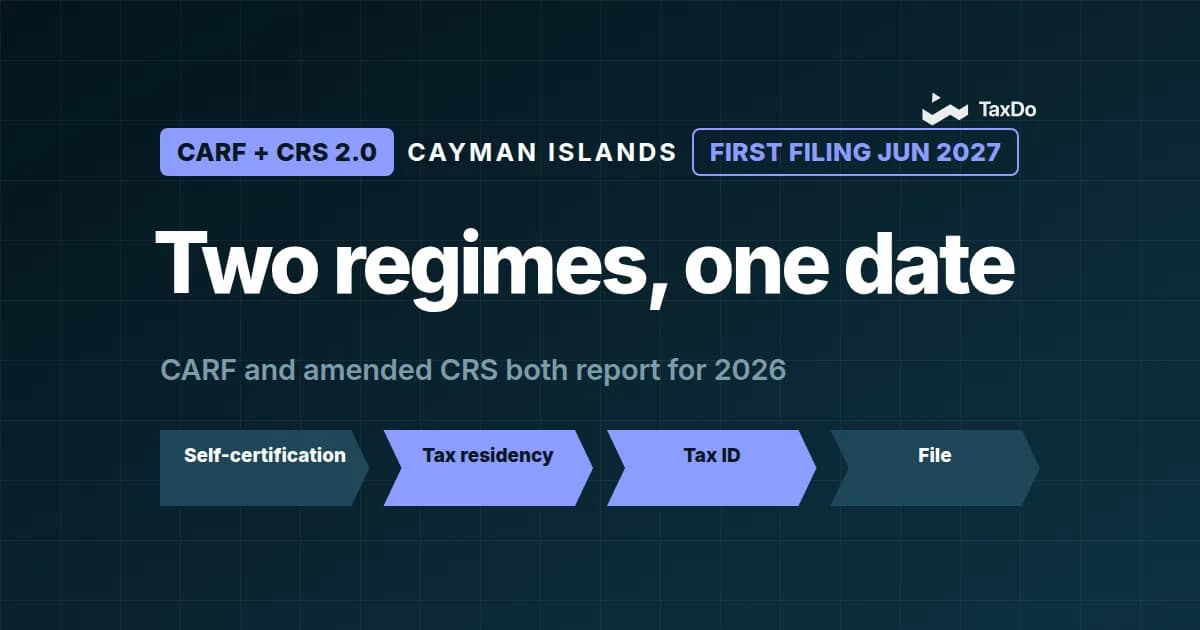
Why the “Wait-and-See” Strategy Will Fail in 2026
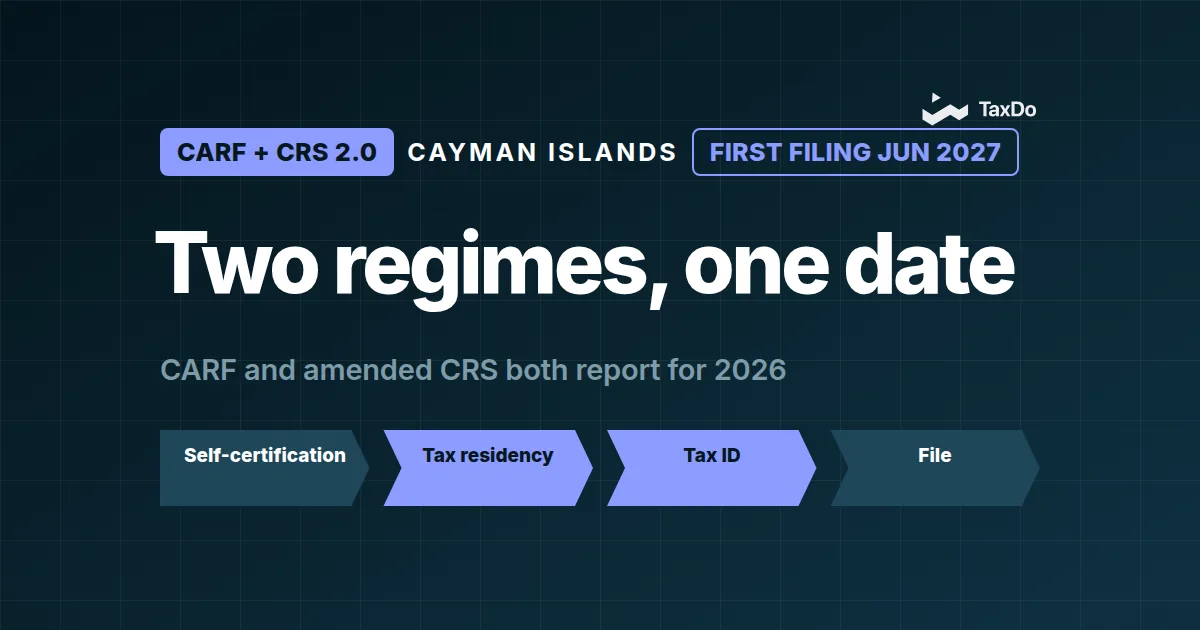
From 1 January 2026, the Cayman Islands enters a new era of tax transparency. The jurisdiction will simultaneously implement the OECD’s Crypto-Asset Reporting Framework (CARF) and the amended Common Reporting Standard (CRS 2.0).
For Cayman-based Reporting Crypto-Asset Service Providers (RCASPs) and Reporting Financial Institutions (RFIs), this is not merely a reporting update—it is a fundamental shift in operational liability. The “wait-and-see” strategy, often used for regulatory updates, is now a direct pathway to enforcement action.
While the first reports are not due until 2027, the statutory obligation to collect validated data begins immediately on Day 1 (1 January 2026). Under the Tax Information Authority’s (TIA) strict enforcement regime, non-compliance triggers administrative penalties (capped at CI$50,000 for primary breaches), and enforcement guidelines provide for imputed liability of directors/managers in defined scenarios.
Critical Timeline: The “Hidden” 2026 Deadline
Many institutions are fixated on the 2027 filing dates, missing the immediate operational risks. The obligation to gather accurate, validated data kicks in the moment 2026 begins.
| Milestone | Date | Cayman Operational Requirement |
| Go-Live (Day 1) | 1 Jan 2026 | Strict Due Diligence Starts: Begin collecting CARF data and updated CRS 2.0 fields for all New Accounts. Obtain and validate self-certifications at account opening. Action: Confirm Cayman-resident PPoC plan now. |
| RCASP Registration | 30 Apr 2026 | Cayman-based RCASPs must register with the TIA via the DITC Portal and update customer notices/terms to reflect CARF reporting obligations. |
| RFI Registration (Legacy) | 30 Apr 2026 | Entities that became RFIs in 2025 must complete registration. Note: They have until 31 Jan 2027 to appoint a Cayman-resident PPoC if they haven’t already. |
| RFI Registration (New) | 31 Jan 2027 | Entities becoming RFIs after 1 Jan 2026 must register by this date. Critical: By this date, ALL existing registered FIs must have updated their record to appoint a Cayman-resident Principal Point of Contact (PPoC). |
| First Filing | 30 Jun 2027 | Submit CARF and amended CRS reports for the 2026 calendar year via the TIA’s portal, accompanied by the mandatory CRS Compliance Form. |
Operational Recommendation: Implement a hard gate for new accounts—no trading until a valid self-certification is obtained and validated. Relying on the limited “temporary lack of self-certification” rule is operationally risky and should be reserved for exceptional cases only. Existing registered FIs must file a change notice to nominate a Caymanresident PPoC by 31 Jan 2027.
Who Is in Scope? (The Due Diligence Matrix)
The Cayman regulations cast a wide net. Determining your obligations depends not just on who you are, but when the account was opened.
1. Cayman-based RCASPs (Crypto Service Providers)
- Scope: Entities providing exchange services (crypto-to-fiat/crypto-to-crypto) or custodial wallet services. This includes exchanges, brokers, dealers, and custodians.
- Operational Impact:
- New Users (> 1 Jan 2026): You must obtain and validate a selfcertification at the time of account opening; if a valid selfcert is not provided, do not open the account.
- Pre-existing Users (< 31 Dec 2025): Apply CARF duediligence procedures and prioritise remediation in 2026 so your 2026 transaction reports (filed in 2027) are adequate, accurate and current. Maintain evidentiary records of outreach, validations, and exceptions.
2. Electronic Money Institutions (EMIs) & SEMP Issuers
- Scope: CRS 2.0 expands the “Financial Institution” definition to capture Specified Electronic Money Products (SEMPs) and Central Bank Digital Currencies (CBDCs). Fintechs and stablecoin issuers previously out of scope may now be classified as Reporting FIs.
- Operational Impact:
- New Accounts (> 1 Jan 2026): Immediate Capture. Accounts opened from Day 1 are “New Accounts” under CRS. You must obtain a valid self-certification including the new CRS 2.0 data fields (e.g., distinct Controlling Person roles) before the account is active.
- Pre-existing Accounts (< 31 Dec 2025): Treat them under CRS preexisting account rules and remediate to capture new CRS 2.0 fields. For certain controllingperson roles, Cayman’s transitional relief applies — report only if available in electronically searchable data until the 30 Jun 2028 filing (for the 2027 year).
3. Traditional RFIs (Funds & Banks)
- Scope: Existing Reporting FIs must upgrade their systems to capture granular data required by CRS 2.0.
- Operational Impact:
- New Accounts (> 1 Jan 2026): Enhanced Data Capture. You cannot use old onboarding forms. You must immediately capture the precise role of every Controlling Person (e.g., “Senior Managing Official” vs. “Beneficial Owner”) and confirm whether the account is a “Pre-existing” or “New” account.
- Pre-existing Accounts (< 31 Dec 2025): Transitional Relief. You are not required to immediately contact all clients to get the new “Role” fields. This data is only reportable for pre-existing accounts if it is already available in your electronically searchable data. If not, you have until the 30 June 2028 filing (reporting for the 2027 year) to fully capture this distinct data point. Failure to remediate generally may result in undocumented account treatment and enforcement exposure.
Day 1 Roadmap for Cayman Compliance
To minimize exposure, Chief Compliance Officers should implement a phased, proactive strategy.
Phase 1: Pre-Day 1 Preparation (Now – 31 Dec 2025)
- Gap Assessment: Assess your pre-existing accounts to identify missing data fields (e.g., crypto-asset identifiers, transaction details, specific Controlling Person roles).
- Appoint a PPoC: You must designate a Cayman-resident Principal Point of Contact (PPoC). This individual must have access to all necessary data to respond to TIA queries.
- Update Operating Models: Embed multilingual self-certifications directly into your onboarding flow.
Phase 2: Day 1 Execution (1 Jan 2026 Onward)
- “No Cert, No Service” Policy: Enforce a strict block on new accounts. Do not allow trading until a self-certification is obtained and validated.
- Automated Remediation: Immediately trigger remediation for pre-existing accounts that lack CRS 2.0/CARF data.
- Rigorous TIN Capture & Validation: Obtain a TIN where required by the customer’s tax residence; validate syntax/format against jurisdiction rules and document exceptions (e.g., jurisdictions that do not issue TINs). Use OECD/DITC references and keep evidence for audit.
- Indicia Checks: Automated systems must cross-reference collected data against your client portfolio to detect “Conflicting Indicia” (e.g., a Cayman address for a user claiming UK tax residency).
How TaxDo Helps — Built for Cayman Day1 & 2027 Filings
Outcomes you can measure in weeks, not quarters.
Manual compliance processes cannot survive the scrutiny of the TIA’s new enforcement regime. TaxDo provides a white-labelled, automated infrastructure tailored for Cayman Financial Institutions, designed to satisfy your CCO, Head of Tax, and CIO simultaneously.
1. Unrivaled Global TIN Validation (The Only “Source of Truth”)
We do not just “check the format”; we verify the existence of the taxpayer.
- The Only Official Lookup Provider: TaxDo is the only provider globally with direct access to 125+ tax authority databases for official, real-time TIN lookups.
- Complete Syntax Coverage: For broader global coverage, our engine enforces strict syntax validation across 205+ jurisdictions, detecting the correct format for all tax types (Personal Income Tax, Corporate Tax, VAT/GST) in complete alignment with official tax authority guidelines.
2. Speed & Efficiency (For Ops & Compliance)
- Day1 Onboarding Gate live in ≤14 days: We deploy dynamic, whitelabel selfcertification modules fully integrated into your current systems. No multi-quarter IT projects—just plug and protect.
- CRS/CARF Remediation Sprint: Reduce manual workload by up to 90%. Our platform can process and start remediating hundreds of thousands of accounts in as little as 24 hours.
3. RegulatoryAligned Deliverables (For Tax Reporting)
- Indicia Forensics & Curing: We do not just validate; we investigate. Our engine cross-checks profiled data to find all possible conflicting indicia (e.g., address vs. tax residency) and offers automated curing solutions to resolve issues before they become reportable breaches.
- DITC Portal Readiness: Get required data for Account Holders and Controlling Persons verified and digitally signed in full alignment with CRS XML v3.0 & CARF XML schemas, ensuring your filings are accepted without technical rejections.
- selfcert validity, TIN syntax/reasonableness checks, and exception documentation, directly supporting your CCO’s penalty avoidance strategy.
4. Security & Sovereignty (For the CIO)
- Bank-Grade Control: We offer segregated environments and deletionondemand capabilities, backed by SOC/ISO controls to meet strict internal banking and data sovereignty requirements.
Pick Your Path to Compliance
- Option A: Request a 24hour Remediation Scan → Receive a risk heatmap, remediation plan, and “timetogreen” estimate for your legacy back-book.
- Option B: Start the “Day1 Gate in 14 Days” Workbook → We ship the whitelabel module and validation rules, then cut over to live protection.

Conclusion: 1 January 2026 is the Point of No Return
The Cayman Islands’ commitment to CARF and CRS 2.0 is absolute. With the TIA’s expanded toolkit of administrative fines and imputed liability for directors, the cost of non-compliance has never been higher.
Institutions must shift from assessment to operational execution. Ensure your data infrastructure is ready for Day 1. Eliminate risk and automate your Cayman compliance with TaxDo.